


An Art Deco fireplace can transform an ordinary room into a showstopping interior with almost unmatched impact. To create one successfully, you’ll need more than a decorative surround: define its geometric style, choose luxurious materials, coordinate a disciplined colour palette, and frame it with purposeful décor. Balance vintage character with modern safety, then position furniture and lighting to reinforce its role as the room’s focal point. The right details will determine whether it feels refined or overdone.
Key Takeaways
- Emphasize Art Deco character with geometric shapes, stepped silhouettes, chevrons, fan motifs, and a restrained palette of black, cream, brass, or bronze.
- Make the fireplace the room’s focal point by centering it on a primary sightline and arranging furniture to face it.
- Combine luxurious materials such as veined marble, polished tiles, lacquered wood, mirrored surfaces, and metallic trim for dramatic contrast.
- Keep surrounding décor balanced with symmetrical sconces, a geometric mirror, restrained mantel accessories, and repeated finishes throughout the room.
- Prioritize safety by inspecting the chimney and firebox, installing carbon-monoxide detection, maintaining clearances, and using certified inserts when necessary.
Define Your Art Deco Fireplace Style

Define your Art Deco fireplace style by choosing the design elements that best express the era’s signature glamour: geometric forms, stepped silhouettes, rich materials, and controlled symmetry.
First, decide how boldly you want the surround to speak. Polished marble, lacquered timber, mirrored tile, or bronze can establish the right level of drama without overwhelming your room.
Choose a limited palette, such as black and cream with brass accents, to keep the composition refined.
If your home leans traditional, let subtle Victorian charm appear through a carved mantel or tailored detailing, but avoid ornate excess.
For a country setting, introduce rustic warmth with honed stone or dark wood, then balance those textures with sleek metal or glass.
Your fireplace should feel glamorous, intentional, and compatible with the architecture.
Choose Geometric Shapes and Strong Symmetry
Embrace angular motifs—such as stepped edges, chevrons, and fan shapes—to establish an unmistakable Art Deco character.
Center your fireplace on the room’s main axis so it commands attention and anchors the layout.
Balance repeating patterns across tiles, metalwork, or furnishings to create a polished, cohesive composition.
Embrace Angular Motifs
Geometric shapes and strong symmetry give an Art Deco fireplace its unmistakable presence, so look for stepped profiles, sharp angles, and balanced proportions in the mantel, surround, and tilework.
Build on that structure with angular motifs that repeat across the room. Choose chevrons, fans, zigzags, or sunbursts, but limit your palette to two or three patterns so the design stays refined.
Echo the fireplace’s lines in art deco lighting, selecting sconces or pendants with faceted shades and crisp metal frames.
Geometric wall panels can reinforce the rhythm without competing with the surround; use them selectively on an adjacent wall or within built-in cabinetry.
Pair polished brass, chrome, or nickel with stone, lacquer, or dark wood to sharpen contrast.
Keep every edge intentional, and avoid overly ornate details that soften the architectural impact.
Center the Fireplace
Center the fireplace by arranging the room’s main sightlines around its strongest architectural features. Position it on the primary wall, ideally opposite the entry or aligned with a central window, so the eye lands on it immediately.
During fireplace installation, confirm that the firebox, chimney, and hearth sit on one clear axis; even a slight offset can weaken Art Deco’s disciplined effect.
Choose a geometric surround with crisp verticals, stepped edges, or a strong arch, then reinforce its importance with a decorative mantel sized to the wall.
Keep adjacent furniture directed toward the fireplace rather than competing with it. Use measured spacing on both sides, and check the composition from every entrance.
If the room’s architecture prevents perfect centering, center the fireplace within its wall and make that boundary feel intentional.
Balance Repeating Patterns
Once you’ve centered the fireplace, balance the room with repeating geometric shapes and strong symmetry. Echo its stepped mantel, fan details, or brass lines in nearby furniture, rugs, lighting, and artwork. Keep each reference intentional; two or three coordinated repeats create pattern repetition without making the room feel busy.
Choose shapes with a similar visual weight, such as circles paired with arches or diamonds paired with chevrons. Use symmetry to frame the fireplace: place matching sconces, chairs, or cabinets on either side, then vary accessories slightly to avoid a staged appearance.
Limit your palette to the fireplace’s dominant finishes, adding one controlled accent color for depth. This approach creates visual harmony while preserving the bold focal point. Step back frequently and remove anything that competes with the mantel.
Select Luxurious Fireplace Materials and Finishes
Choose opulent stone, such as marble or granite, to give your fireplace a commanding foundation.
Add metallic accents in brass, bronze, or chrome, then layer glossy finishes to reflect light and heighten its Art Deco character.
Choose Opulent Stone
Opulent stone gives an Art Deco fireplace the polished presence this style demands, so consider book-matched marble, richly veined quartzite, or dark granite with subtle metallic flecks.
Marble elegance creates a luminous focal point, especially when dramatic veining flows continuously across the surround. Choose a honed surface for understated sophistication or a polished finish to amplify light and pattern.
For high-traffic rooms, granite durability offers dependable resistance to heat, scratches, and daily wear without sacrificing visual impact.
Quartzite provides a compelling middle ground, pairing marble-like movement with excellent hardness.
Before ordering, request full slabs and confirm their dimensions against your fireplace design. You’ll achieve the strongest result when the stone’s scale, veining, and tone complement the room rather than compete with its architecture.
Add Metallic Accents
Metallic accents sharpen the polished effect of opulent stone while reinforcing Art Deco’s geometric character. Choose one dominant metal and repeat it deliberately across the fireplace surround, screen, and nearby lighting. Brass adds warmth, while chrome or nickel delivers a cooler, streamlined statement. Use metallic textures to create depth without competing with dramatic veining or sculptural stonework.
- Frame the opening with slim brass trim for a precise, architectural outline.
- Select a geometric fire screen with a controlled metallic pattern.
- Echo the chosen finish in sconces, irons, or a small mantel accessory.
Balance matters: concentrated shiny accents look intentional, whereas scattered metals can make the composition feel restless. Match the scale to your fireplace; substantial surrounds need stronger detailing, while delicate trim suits compact designs.
Before installation, confirm every finish tolerates heat and clean it according to the manufacturer’s guidance. This approach creates cohesion and lasting visual authority.
Layer Glossy Finishes
Layer glossy finishes to give your Art Deco fireplace a refined, light-catching presence without overwhelming its geometry. Choose polished marble, lacquered cabinetry, or glazed tile to introduce controlled shine around the surround. Let one material lead, then use complementary glossy finishes in smaller doses so the design feels layered rather rather than busy.
For example, pair a veined marble mantel with deep lacquer on adjacent shelving, or frame geometric tiles with a satin-brass trim. Reflective surfaces amplify firelight and make a room feel more spacious, but placement matters.
Keep the hearth practical with honed stone or textured tile to disguise soot and resist slipping. You’ll create contrast by balancing brilliant surfaces with matte walls, woven textiles, or natural wood.
Clean lines and disciplined repetition will preserve the fireplace’s Deco character while maximizing its luminous impact.
Match Colours to Your Art Deco Fireplace
Choose colours that reinforce your Art Deco fireplace’s geometry and materials rather than competing with them. Build color harmony by identifying one dominant finish, one supporting shade, and a restrained accent. Your paint palettes should echo the surround’s marble veining, metallic trim, or deep lacquer without copying every tone.
- Pair black marble with warm ivory walls and muted brass accents.
- Balance emerald, navy, or burgundy surrounds with soft greige or cream.
- Use terracotta, blush, or ochre selectively against dark, polished finishes.
Test large samples beside the fireplace in daylight and lamplight; undertones can shift dramatically. Keep adjacent walls quieter when the surround carries strong pattern, and choose a ceiling shade that maintains visual height.
Repeat selected colours through upholstery or flooring only where they support the fireplace’s established palette, not where they create distraction.
Frame the Fireplace With Statement Décor
Once your colour palette feels balanced, frame the Art Deco fireplace with statement décor that reinforces its geometry without obscuring it. Place a pair of tall, symmetrical objects—such as fluted vases, sculptural lamps, or stepped pedestals—on the mantel or adjacent console.
Choose finishes that echo the surround’s metalwork, including brass, chrome, or blackened steel, to create a cohesive visual rhythm. A large geometric mirror can amplify light and extend the fireplace’s vertical emphasis.
Carefully selected artwork adds personality without competing with the focal point. Keep accessories varied in height, but preserve breathing space around the firebox.
For Vintage charm, introduce one period-inspired piece; for modern elegance, balance it with a crisp, contemporary form. Edit ruthlessly: every object should support the fireplace’s architectural presence.
Balance Vintage Character With Modern Safety
Preserve the fireplace’s period character, but bring its performance up to modern standards. You can retain vintage charm while prioritizing modern safety through discreet upgrades that respect the original design.
- Have a qualified professional inspect the chimney, flue, firebox, and surrounding masonry before use.
- Install a correctly sized liner, carbon-monoxide detector, and appropriate fireguard for dependable protection.
- Choose a certified gas or electric insert if the original fireplace can’t safely support solid-fuel burning.
Repair damaged tiles, repoint loose joints with suitable mortar, and replace missing components with sympathetic reproductions rather than guesswork.
Keep combustible furnishings, curtains, and décor at the distances required by local codes. Don’t paint over ventilation openings or conceal safety controls.
Arrange annual servicing and sweep the chimney regularly. These measures let you enjoy authentic materials and period detailing without compromising everyday confidence, comfort, or responsible operation.
Make Your Art Deco Fireplace the Focal Point
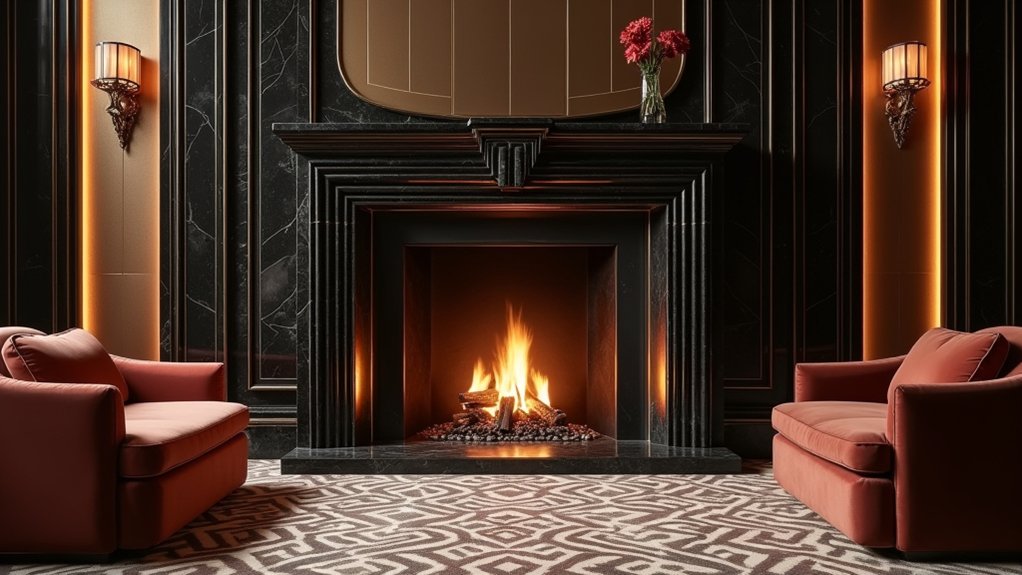
Make the Art Deco fireplace the room’s visual anchor by arranging furniture and lighting to draw attention toward its geometric lines, rich materials, and distinctive craftsmanship. Position your sofa and chairs to face it, while preserving clear walkways and comfortable conversation zones.
Choose a restrained mantel display: one sculptural object, a mirror, or symmetrical artwork can reinforce the period’s disciplined glamour without creating clutter. Layer directional sconces or dimmable recessed lights to highlight tile, metalwork, or veined stone after dark.
Repeat one fireplace finish elsewhere, such as brass in a side table or black lacquer in cabinetry, to create cohesion. Balance polished surfaces with a Rustic texture, like woven upholstery or aged wood.
Finally, add warm lamps, textiles, and firelight for a Cozy ambiance that keeps the focal point inviting, not merely decorative.
Frequently Asked Questions
Can an Art Deco Fireplace Be Installed in a Room Without an Existing Chimney?
Yes, you can install an Art Deco fireplace without an existing chimney. Choose an electric or balanced-flue gas model, confirm ventilation requirements, then enhance it with a Decorative mantel and thoughtful Material choices for authentic character.
How Much Does It Typically Cost to Create an Art Deco Fireplace Feature?
You’ll typically spend $5,000–$15,000, depending on installation, ventilation, and craftsmanship. Request a detailed cost estimate, then refine material selection: reclaimed tiles, bespoke metalwork, or marble can substantially increase your final budget.
Which Heating Options Work Best for an Art Deco-Inspired Fireplace?
Choose electric or balanced-flue gas heating for efficient, controllable warmth without compromising Art Deco lines. Use Vintage materials around the surround, while Modern adaptations conceal controls, improve safety, and simplify maintenance for today’s lifestyle.
Can Renters Incorporate Art Deco Fireplace Details Without Making Permanent Alterations?
Yes, you can add Art Deco character without permanent changes. Choose a freestanding decorative mantel, removable geometric wallpaper, metallic mirrors, and vintage accessories. Use adhesive hooks, avoid drilling, and preserve existing walls and finishes.
How Should an Art Deco Fireplace Be Maintained Throughout the Year?
You don’t need constant scrubbing: schedule seasonal fireplace cleaning, inspect vents, and dust decorative mantels gently. Protect lacquer, brass, and tile with suitable products, address soot promptly, and arrange annual professional servicing for safety.
Conclusion
With the right approach, your Art Deco fireplace can become the room’s pièce de résistance. Define its geometry, repeat symmetrical shapes, and layer marble, metal, and jewel-toned colour for unmistakable glamour. Add statement décor without crowding the surround, then pair vintage character with modern safety features. Finally, arrange seating and lighting to direct attention naturally. Get these details right, and your fireplace won’t merely warm the room—it’ll steal the show with timeless confidence.